WRENCH GLOSSARY
Last updated 26 November 2004
| HOME
| LINKS | PATENT SEARCHING
| WRENCH OF THE MONTH
|
Another categorization of wrenches is contained within the "type" search of the DATAMP database. The textual array underlying that menu is available to DATAMP's "data stewards."
Each of the the illustrations is one example within the category. Most of the categories include such a wide range of designs that it is arbitrary to select one as "typical." Illustrations were copied from MVWC Newsletter back issues, and a 1923 edition of the Michigan Hardware Company wholesale catalog.
- Alligator (Jaws open at acute angle,
-
 one or both jaw faces have teeth, to accommodate multiple sizes with one opening. Some designs are
 -
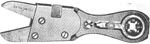 adjustable. )
- Angle Nut
-
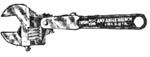 (head is adjustable with relation to handle, so angle of opening can be changed in relation to center line of handle. Some have fixed size openings, some have adjustable jaws.)
- Assembly and Equipment Adjusting (many are stamped steel; some have part numbers or names )
- Automobile, Motorcyle, and other vehicle Marque The best guides to these tools are publications and web sites devoted to the interests of vehicle collectors and restorers. Several auto brands and models have their respective collector clubs and resources.
- Basin
-
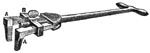 (to reach the pipes and fittings on the underside of sinks, in behind the bowl.)
- Bicycle / Pocket
-
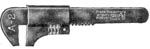 (the peak of production and diversity for these small wrenches came with late 19th & early 20th Century interest in bicycles and the first automobiles. Some of them are the "smallest" of a range of sizes; others were made only in the small size. )
- Bone & Rotating Socket Bone
-
 (multiple sizes at both ends of a handle; most are hexagonal )
- Brace Wrench (The primary intended market for the
-
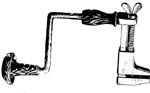 19th Century adjustable patents appears to have been general handyman use and buggy and wagon axle nuts. Some have grooved jaws to hold the tang of standard augur and twist drill bits. The design carried over into various
 -
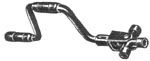 "Rim Socket" designs and "Speeder" handles. )
- Buggy
(These typically have -
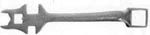 one box end to fit an axle nut combined with several open end sizes to fit standard carriage bolt nuts used in the vehicle's body; some have some type of
 -
 clamp or spring to hold the axle nut firmly so the user would not have to touch the grimy axle nut. )
- Buggy & Wagon Axle Nut (Wagon and buggy axles had crude bearings which required frequent lubrication. Wrenches to remove the wheels so the axle hubs could be lubricated came in a wide range of
-
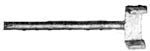 fixed or
 -
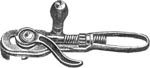 adjustable sizes; part of the design may attempt to keep the user's hands clean by firmly holding the filthy axle nut. Some included built-in oilers. )
- Chain & Strap (
-
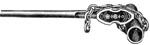 chains and
 -
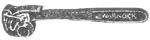 straps can be drawn tight to grip round or irregular surfaces; straps can grip without marring a smooth or polished surface. There are a few designs with
 -
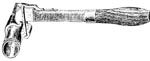 two- or three-piece jaws
or "girths" also intended to grip round surfaces without marring )
- Cut-out-letter Malleable Implement
-
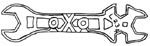 (company names spelled out or abbreviated in free-standing letters or letters cut out in the center web of a wrench which has one or more openings at each end)
- Implement & Machinery (may be identified only by comparison to illustrations in a manufacturer's repair parts lists or other product documentation. May have
-
 manufacturer name,
-
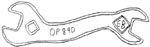 logo,or
 -
 part number
Some may be normal manufactured items with an added marking. )
- Monkey Wrench (term first documented in early 19th Century British machine tool industry pattern books -- used primarily for smooth jaw wrenches with a screw or knurl adjust on or parallel to the main handle.)
- Pipe (all pipe wrenches with teeth to grip round surfaces have to make some provision for jaw movement to avoid "locking" -- getting stuck on the work)
- Pipe Tongs
-
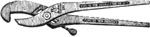 (Larger sizes were used in water distribution systems, oil and gas industries, etc. Used primarily in the last half of the 19th Century -- they were superceded by chain wrenches, adjustable and self-adjusting pipe wrenches )
- Pliers & Locking Pliers (including designs intended to:
-
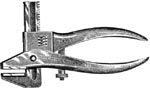 keep jaws parallel,
 -
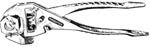 multiply the gripping force applied by the jaw surfaces, or
 -
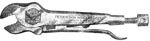 clamp the tool to the work until it is released )
- Quick-Adjust Nut (many use some type of
-
 wedge action, or
 -
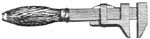 fine teeth held in mesh with a spring, others use a
 -
 hinged handle which engages a rack. )
- Quick-Adjust Pipe (many share the same basic
-
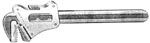 spring and rack or
 -
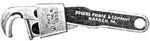 wedge adjustment as the quick-adjusts intended for use on nuts, but with a different jaw face.
 -
 roller jaw types
have no counterparts among the nut wrenches.
- Ratchet
-
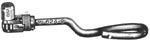 (some designs can release and get a new grip in as little as 5 degrees of motion )
- Revolving Head
-
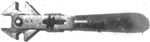 (a range of fixed sizes around the outside of a rotating section -- the size selected for use is locked to the handle by a spring loaded catch or sliding bolt of some kind)
- "S" (refers to general shape of wrench; may have
-
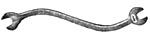 fixed or
 -
 adjustable sizes --
many early 20th Century adjustable wrenches had 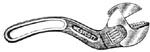 curved or "s" shaped handles )
- Screw Adjust Nut
-
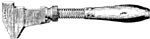 Adjustment on shank ;
 -
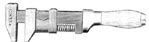 adjustment parallel to shank;
 -
 adjustment at angle to shank
- Screw Adjust Pipe (jaw faces with ridges or teeth to grip round surface)
-
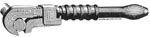 Adjustment on shank ;
 -
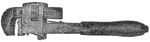 adjustment parallel to shank;
 -
 adjustment at angle to shank
-
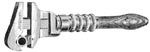 Screw Adjust Pipe & Nut Combination (many of these have openings on opposite sides of the handle -- one side for nuts, the other for pipe )
- Self-Adjusting (most have some variation of a swinging jaw segment which closes in on a jaw face attached to the handle -- the jaws may be shaped to accomodate pipe, flat surfaces, or both )
- Socket (Sockets of various shapes
-
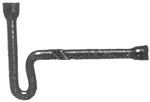 may be fixed to a shank and handle,
 -
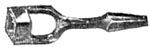 designed to be used in a brace, or
 -
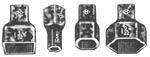 designed as part of a set to be interchanged on a common handle )
- Spoke Nipple (various designs ranging from
-
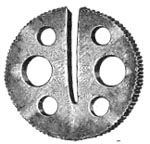 simple to
 -
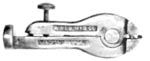 complex
to turn the nipples which attach wire spokes to wheel rims of bicycles, motorcyles and the like. Adjusting the spoke tension balances and "trues" the wheels. )
- Threshing Machine Cylinder Tooth
-
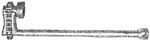 (designed to turn the nuts holding teeth to the outside of a drum in threshing machines. These wrenches made it possible to tighten or replace teeth without removing & disassembling the entire drum)
- Tire Bolt
-
 (specialized to tighten small bolts which held iron rims ("tires") on to the outside of wooden buggy and wagon wheels)
- Wrench Combination tools (a wrench feature combined with other tool functions. These other functions may include
-
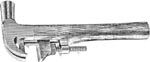 hammer, pliers,
 -
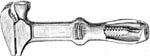 screwdriver, etc. Some
 -
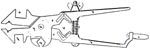 seemingly impractical but
 -
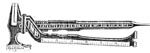 fascinating gadgets fall into this category.)
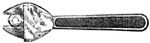 Nut,
Nut, 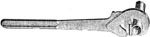 Pipe,
Pipe, 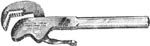 Combination